

Sometimes, both sides are right in a debate! ⚖️
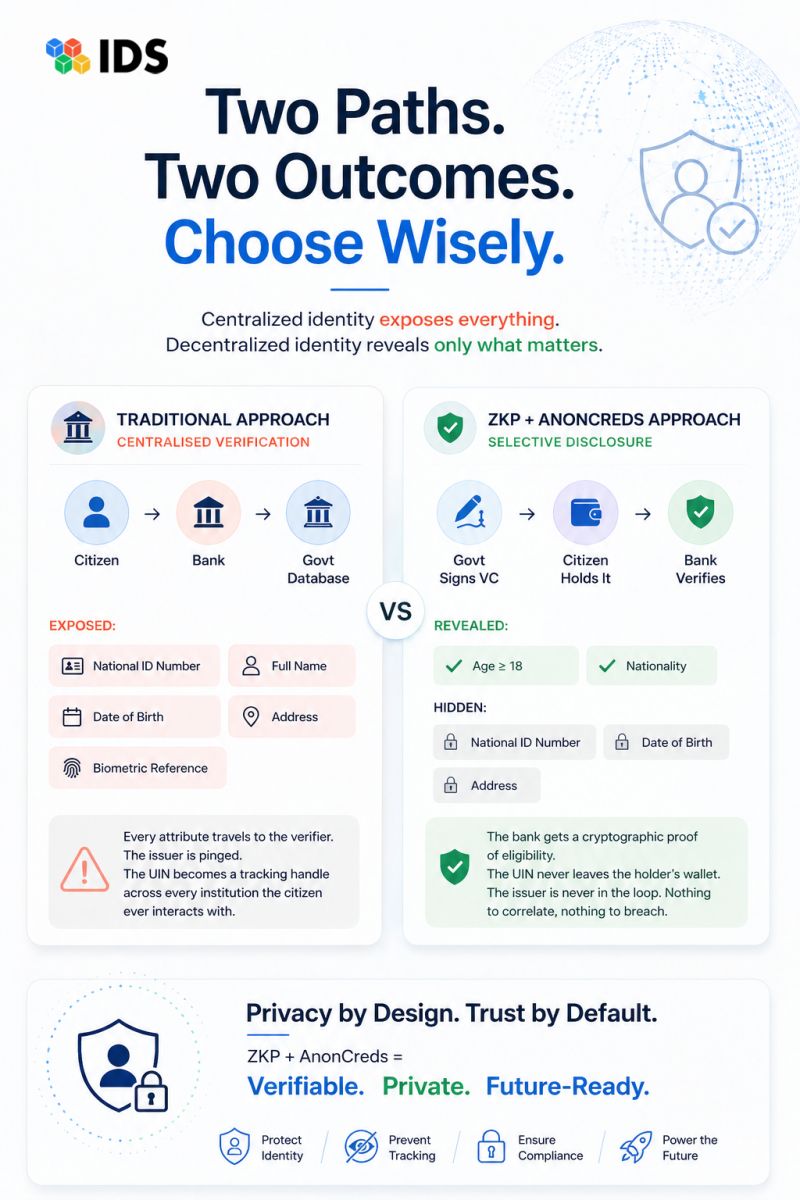
For instance, is a Unique Identity Number (UIN) embedded in a National ID a tool for interoperability 🔗, or a handle for surveillance?
The real question isn’t whether to have a UIN in the National ID. It’s whether that number needs to travel every time the credential is used.
With Zero-Knowledge Proofs and AnonCreds, it doesn’t have to.
Here’s what that looks like in practice:
🌾 A Farmer ID holder proving subsidy eligibility to a government agency shouldn’t need to hand over their National ID number.
🧕 A refugee proving age to a health worker shouldn’t expose their full registration record.
🏦 A citizen proving nationality to a bank shouldn’t leave a trail that links to every institution they’ve ever visited.
The UIN debate is not a policy question, but actually a schema design question.
When you issue VCs using AnonCreds and Hyperledger Indy, the credential holds the UIN, but the holder controls if it is ever revealed. The verifier gets a ZKP: a mathematical guarantee ✔️ that the underlying attribute satisfies the condition, with nothing else attached.
The selective disclosure isn’t a privacy feature added on top; rather, it is the default behaviour of the protocol ⚙️.
The question isn’t if your national ID credential should contain the UIN. It should, because the government signed it 🏛️, and that signature is the root of trust.
The question is whether the UIN needs to travel every time the credential is used. With ZKPs, it doesn’t.
We build VC issuance and verification infrastructure on Hyperledger Indy to issue National IDs, Farmer IDs, Health IDs, Refugee IDs, and social protection credentials across multiple countries 🌍. This is the architecture that makes privacy-preserving identity real, not just a promise.
Let’s take this further, Let’s talk. Join us at ID4AFRICA Conference Stall No. L05🤝
